In the world of the Internet, everything moves at lightning speed (unless you still have dial-up). Now, something many people thought was a bit more concrete is changing too. When you think of a website, you probably think of website.com or website.org. Recently, there has been a push for website.co or website.me but these were always overshadowed by the domain king: .com.
Unfortunately for .com, there has been a power shift. The Internet Corporation for Assigned Names and Numbers (ICANN) is now offering what they call generic top-level domains (gTLD). Major companies are scrambling to claim these domains as quickly as possible. In this blog post, we’ll take an in-depth look at top-level domains, as well as what they mean for SEO. Then you can decide whether to support the new ruler or stick with the current monarch.
It's barely been a day and already the questions are pouring in about gTLDs. How will they affect SEO? Do I need to register my company name? Will I automatically get a TLD if I have a trademark on the term? Here are some of the basic questions answered.
Basically, generic top-level domains eliminate the need for .com, .net, or .org (the historic TLDs) and replace those with things like .yourproduct, .brand, .yourcompanyname. For example, .icecreamstore would be a top-level domain name. If you run the Ice Cream Store and that was your domain name, you could create landing pages called chocolate.icecreamstore, vanilla.icecreamstore, and more. The alternative, icecreamstore.com/chocolate, could become a thing of the past.
Registering .yourcompanyname is a bit more complicated than going to GoDaddy.com (or other domain registration services) and just buying the name. To get your own gTLD, you have to submit a detailed application to ICANN (the submission deadline for this round was in April). ICANN will then determine whether to grant the applicant with the requested domain.
ICANN’s evaluation process is complex and lengthy, sometimes as long as nine months. The fee just for the application and evaluation is $185,000!! That's right - $185,000 – so at this time, only big businesses with large budgets are likely to apply.
Well, that remains to be seen; however, big names like Google seem to think so. According to their blog, Google applied for top-level domains such as .google and .youtube. Other major companies have applied for top-level domain names as well. For an enterprise company, it would certainly be valuable to have a top-level domain name. With it being so exclusive right now, it would impart a sense of authority and power and set a company website apart from others on the Internet.
ICANN will reveal the full list of all the generic top-level domain names with applications tomorrow, June 13, 2012. They will be holding a press conference in London, but you can also see the list online here. Since not all companies have made their application status public, it will be interesting to see who has applied – or not applied – for what top-level domains.
At this point, unless you are a major Fortune 500 company, you probably don’t need to worry about top-level domains. At $185,000 a pop, it's unlikely that you’ll anyone BUT big companies with them. This raises an interesting question though - will brand TLDs help reduce webspa? Think about it - how many SEO or domain squaters can afford to set up a generic lead-generation site on .rockvilleplumbers? Outside of Service Magic, not many.
One of the biggest challenges on the web today is how to effectively fight spam. Google's latest update dubbed "Penguin" was designed specifically to target (and penalize) webspam. Eric Schmidt, Google's former CEO, was quoted as saying that the Interent has become a cesspool and that established brands are the answer. Given this statement, isn't it conceivable that Google might start to favor these new branded TLDs over traditional TLDs like .com and .net? It certainly seems reasonable to us.
This is something we'll have to monitor closely over the coming months and years. If they become more common, show an SEO boost, and/or prices begin to drop, gTLDs will suddenly become VERY important for SEO. Talk to any SEO and he or she will tell you how important an optimized URL is for your site. With top-level domains, URLs are more optimized than ever. How about the-best.icecreamstore or Maryland.icecreamstore? Eliminate the .com and you have the keywords you want right there. There’s more – using a top-level domain will make getting to your site even easier. People can just type in .icecreamstore and be there, taking Google out of the equation all together. If I want to buy some ice cream, I can just type in .icecreamstore and see where I end up. For major chains this could be a huge method of getting traffic – think .shoes or .computers.
There are potential legal complications with the new generic top-level domains (they're like a trademark attorneys dream come true!). A company that doesn’t have its name trademarked might find that someone else has already bought it and is now selling it for a higher price. In addition, there will be a learning curve. People are used to .com domains. Especially for people who didn’t grow up in the Internet age, telling them to visit .icecreamstore instead of icecreamstore.com will just look like a typo (in fact, Microsoft Word is telling me it’s a typo right now).
Businesses will need to own both domain names and re-direct to one or the other. Recently Overstock.com did a big promotion about switching to O.co, but typing in the latter redirects you to their .com site – so it doesn’t look like .co panned out for them.
The smart thing for a company of any size is to keep an eye on the new top-level domains. If/when prices drop and your competitors start buying them up, it’s time for you to consider getting one. After all, at some level, the web is a real estate game - you want to cost-effectively maximize your company's portfolio of media assets. A good online marketing and SEO company will be able to tell you when it’s the right time to buy.
If you’re a small to mid-sized company, the best strategy for you right now is to buy second-level domain names related to your business. Aim for geo-targeted or service-specific domains. Using our ice cream example, the owner could buy mdicecream.com or mdstrawberryicecream.com – the first is the target area and the second refers to a specific kind of ice cream they carry. The more domain names your business owns, the more you can dominate the search results, and the more likely a customer will end up on your site. The new gTLDs are another reminder about how critical it is that you have a comprehensive online marketing and SEO strategy in place!
Need help creating an online marketing strategy that works? Contact Blue Corona today!
Overall rank: 174
Industry: 23
Local / Industry: 1
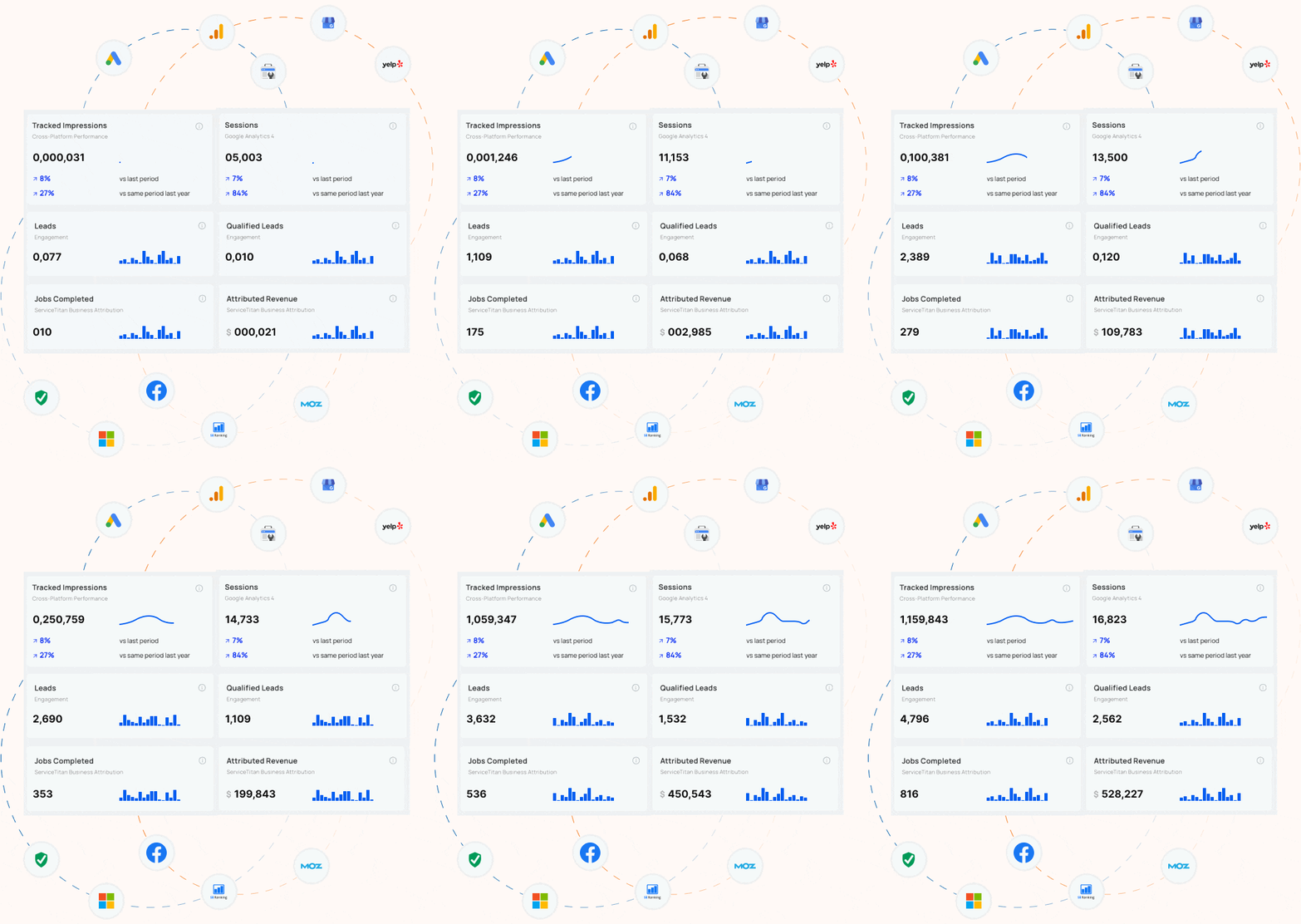
Accurately track every marketing strategy and use never-before-seen insights to improve your marketing ROI
Blue Corona specializes in search engine optimization (SEO), pay-per-click (PPC), email marketing and social media marketing for small (and not so small) businesses.
Need a website or interested in improving your current website's visit-to-lead conversion rates and SEO?